Showing posts with label Naturemill composter. Show all posts

Saturday, March 26, 2011

Everbody Hold Hands and Sing Kumbaya

Sam has been spending lots of time recently studying for her test and has left me to my own devices. I have been passing the time reading lots of gardening blogs. I have also been reading books about garbage production, oh the exciting life of a college professor. The Naturemill has been working great producing good compost in about a week. However, just the two of us have to maxing it out each week. We have been questioning what will happen when the temperature gets warmer and the garden starts producing vegetables. One thing that keeps popping up on the internet blogs are the benefits of vermicompost. So lately I have reading up on worm composting.
Things you might not have known about composting red worms:
- If you cut them in half they do not grow into two worms
- Worms lay cocoons which can contain 2-10 eggs each
- Worm populations can double in 90 days
- Worms can eat half their weight eat day in garbage
- Red worms are not ground dwelling, they live on the decomposing forest floor
- Cardboard is some of a worm's favorite food
- Worms don't actually eat the decomposing material, they are after the bacteria decomposing it
- Worms can climb, can they ever
I bought a pound of red worms and built a worm habitat from an old rubbermaid container. I threw them in and the next morning, WORMS EVERYWHERE! They had climbed out of the container and were all over the garage floor. It's ok, Sam just rolled her eyes too. If you were ever interested, it takes about an hour to pick up 1000 worms. Back to the handy dandy internet. Turns out this is very common the first night. The worms are dehydrated from their travels and not used to their new habitat so they run away. I managed to collect most of the escapees, although I am still finding mummies in weird places. After adjusting their food a little everybody calmed down.
One of a thousand or so red worms pooping black gold in the garage.
After more research the rubbermaid tubs work, but aren't ideal. The air flow is too limited for really good production. With some of my birthday money I bought a Worm Inn. It is a breathable bag with a zipper mesh top and drawstring bottom. Food goes in the top and the finished castings are harvested from the bottom.
I had an extra garbage can that already had a hole in the side that has now literally become a can of worms.
The flow through design means everything is continuous. The worms work towards the top into the new garbage so there isn't too much sorting from the bottom finished material.
The worms eat lots of things that can't go in the Naturemill like cardboard which help to further decrease our garbage production. They love damp cardboard.
Pretty nice. This is now my composting corner of the garage. Once the worms get settled and up their production I have a competition in mind. I'm going to keep track of input and outputs from both systems to see which works better. Two to three pounds of worms should have comparable throughput as the Naturemill.
I never thought I would have a can of garbage eating worms in the garage.

Wednesday, December 15, 2010

Pretty Cool

So I noticed a huge jump in blog hits after I posted the first composter review, but never looked into it. Turns out that our post was featured on the re-nest blog. So it turns out other people are interested in our compost, never thought I would say that. Well I guess that warrants a composter update. I have decided that all of the compost produced this winter is getting piled in one spot in the garden. At this rate, by spring we are going to have a huge pile.
Here is the typical week for the composter. Wednesdays are when I take garbage out so it is day 0 for the composter. I fill it daily from Wednesday to Sunday evening. It is pretty full at this point. I don't add anything Monday or Tuesday and just accumulate scraps for those days. Wednesday morning I dump the compost in the bottom tray in the garden and transfer from the top chamber. Then the accumulated scraps are added to start things off again. So we are looking at a week in the top and a week in the bottom. We consistently add coffee grounds, apple cores, banana peels, egg shells, and toilet paper tubes.

Wednesday, December 8, 2010

Christmas Garlic?

The Christmas decorating is pretty much finished. All of the soft ornaments are on the bottom branches and every morning Nera places them around the house.
Last weekend I turned one of the beds and planted garlic. The garlic will be between our hot peppers. Since the hot peppers don't really get big until later in the summer, the garlic will be finished. I turned in some of the fresh compost which is looking quite good.
For those who care, the composter is working great. We are producing one container per week and everything that can go in is. Last weekend a bunch of fish scraps went in. This morning the feed consisted of a few toilet paper rolls, banana peels, bean cuttings, egg shells, coffee grounds, apple cores, and a ton of those corn starch packing peanuts. I have started a pile in the garden so hopefully next spring we can have a good visualization of how much has been produced.

Tuesday, November 30, 2010

Composter Update

I thought I would do a quick post about the composter since I have gotten lots of responses about it. Week one went great. Week two I started trying other things and got the balance off. I tried leaves and other paper items as brown. I also composted lots of apple and tomato parts. It smelled pretty bad even for the garage. I can only imagine what that would smell like in the house. Well, a little more baking soda and sawdust and everything came back under control pretty quickly.
Here is typical feed for the composter.
Egg shells, garlic pieces, tomato guts, rotten blue berries, moldy sour cream, and a couple toilet paper roll tubes.
Here is the week two compost. Overall it looks pretty good. Oddly enough the dry leaves didn't compost all that well. I put them in whole, mulched probably would be better. I threw in a couple whole peat pots from last season. These sat outside all year and didn't do anything. The few I crumbled up went away. The few I threw in whole really didn't.
Additional lessons after week two. When possible put in small pieces of whatever. When in doubt error on the side of too much baking soda, for smell.

Wednesday, November 17, 2010

Naturemill Composter Review

I finally broke down and purchased a hippie appliance that I have been watching for a couple years. The NatureMill company has a series of home composters. All of the previous models had some issues with design or construction quality so I waited for the latest version to be out a year before I got one. Cities like Toronto and San Fransisco have curb side composting programs, most do not. According to the EPA, kitchen waste is the number 1 least recycled potential item. A third to half of all household waste can be composted. We recycle, but especially as we are trying to eat better, lots of vegetable scraps get thrown away. Compost piles are cheap, but we don't have a good spot for a compost pile, they aren't for many food scraps, and I don't want to carry scraps out there in the winter. So a home composter seemed like a good solution.
The naturemill unit is basically a low density polyethylene cooler. You know those cheap white ones. It is much thicker and nicer and is recycled and recyclable. The unit comprises of an upper mixing chamber and a lower curing chamber. The compostable items go in the top, it mixes every 4 hours. A pump continuously circulates air and then discharges through an activated charcoal filter so it doesn't smell too much. The unit also heats the mixer to 140F for rapid breakdown. The process is supposed to take two weeks, one week in the upper chamber and one in the lower. I got the Pro XE version which has a heavy duty mode. I got one from their direct outlet so it was much cheaper than a straight purchase. There aren't too many people that detail their experience so here goes.
This is the type of items we typically throw out. We started with coffee grounds, a banana peel, a rotten tomato, some tomato scraps, and an apple core. They suggest cutting up any stringy or long pieces so it doesn't tangle in the mixer.
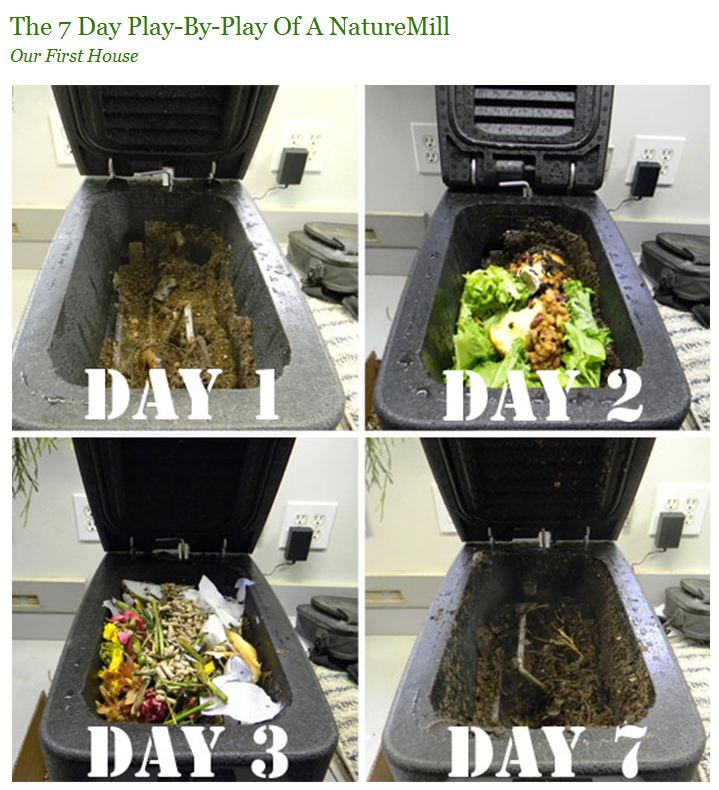
Day 0 (Starting the unit): The scraps go in the top along with a cup of starter soil from the garden. Since kitchen scraps are usually full of water and nitrogen (green) heavy, the pH is balanced with some baking soda and the brown fraction balanced with saw dust pellets. Some pellets were provided to start up. I have an unlimited supply of saw dust from Jerad's shop, but will experiment with other brown replacement items.
Day 1: Not much left already.
Day 2: Yesterday I through in a few items similar to the initial batch.
Day 2 (loaded): More coffee grounds, apple cores, and some rotten lettuce and old baked beans.
Day 3: The breakdown process results in lots of water vapor. At this point we had a steaming pile of compost.
Day 3 (loaded): Ok, it seemed to be working with regular items so I gave it a challenge. An old flower bouquet and some bills went in along with banana peels and the wood pellets.
Day 4: It did pretty well with everything. Although I cut them down, the stems from the flowers probably weren't the best thing since the woody parts take a long time to break down.
Day 4 (loaded): I heard that paper towel and toilet paper rolls are good compost items. I also threw in some newspaper ads. The flower stems were still visible. At this point the machine was pretty full. They state that this unit is suitable for households of 5 and can take 5 lbs of food per day. Although we had people over this weekend and generated lots of scraps, the two of us managed to fill it up quickly.
Day 5: When loaded to the brim some of the stuff builds up on the edges. I scraped the sides down.
Day 5 (loaded): Just to see what happens I kept loading.
Day 6: Almost everything had broken down except for the glossy newspaper which didn't do anything.
Day 7: The instructions say that it takes two weeks to make a batch of compost. They weren't real specific about, is that two weeks in the top or total? Since we filled it up in a couple days and nothing was recognizable after a week, I am going to do one week in top and one in the bottom. I pushed the transfer button and everything went down below. Enough stuff sticks to the sides so you don't need to add new cultures after emptying.
Here is what the bottom tray looks like. The only recognizable pieces were the newspaper pieces and some of the stems from the flowers. So in the first week toilet paper rolls worked well as alternate brown, glossy newspaper ads did not. Real woody stuff like flower stems should probably just get thrown on the garden. Apple cores, banana peels, meat, and dairy weren't a problem at all. The white cup catches compost tea that drips down from the top chamber and can be put on the compost or used to water plants. I am going to let this hang on in the bottom, which is warm and humid, for a week to continue breaking down. Next week this will go outside and the process continues.
I have been pretty amazed at the amount of scraps we put into this thing, now that we consciously choose too. I have noticed that our garbage weighs lots less. If we continue to produce a batch in a week or two, it won't be a stretch to predict 8-10 cf of compost a year out of this thing. Since the composting process reduces the volume by 75%, that is a lot less garbage leaving our house.
Last night we accidental forgot to put a bunch of sweet and sour chicken in the refrigerator. Ever compost sweet and sour chicken, it went in this morning along with some old guacamole. Kind of cool.